
Emotional Resilience Training
For Leaders and Their Teams
If you are a Director or Executive, you know that your team’s performance is only as stable as their internal state. When your managers and high-performers are stuck in patterns of overwhelm, defensive reactivity, or "shutting down" during high-stakes decisions, it creates a bottleneck for the entire organization.
You don't need another theoretical workshop on "well-being." You need a repeatable, science-backed emotional resilience training that equips your leaders to shift their internal state in real-time—ensuring they lead with clarity and presence, even under extreme pressure.
Emotional Resilience Training: Beyond Coping to Nervous System Recoding
Most programs teach leaders how to manage stress. We teach them how to remove the internal triggers that cause it.
The Difference Between "Coping" and "Recoding"
Standard emotional resilience training stays at the surface—teaching leaders to "push through" while the nervous system is still in a state of alarm. Our approach uses Somatic Techniques and Neuroplasticity to address the root: the limiting beliefs and physiological triggers that cause burnout and disengagement.
Our 3-Step Emotional Resilience Training Process
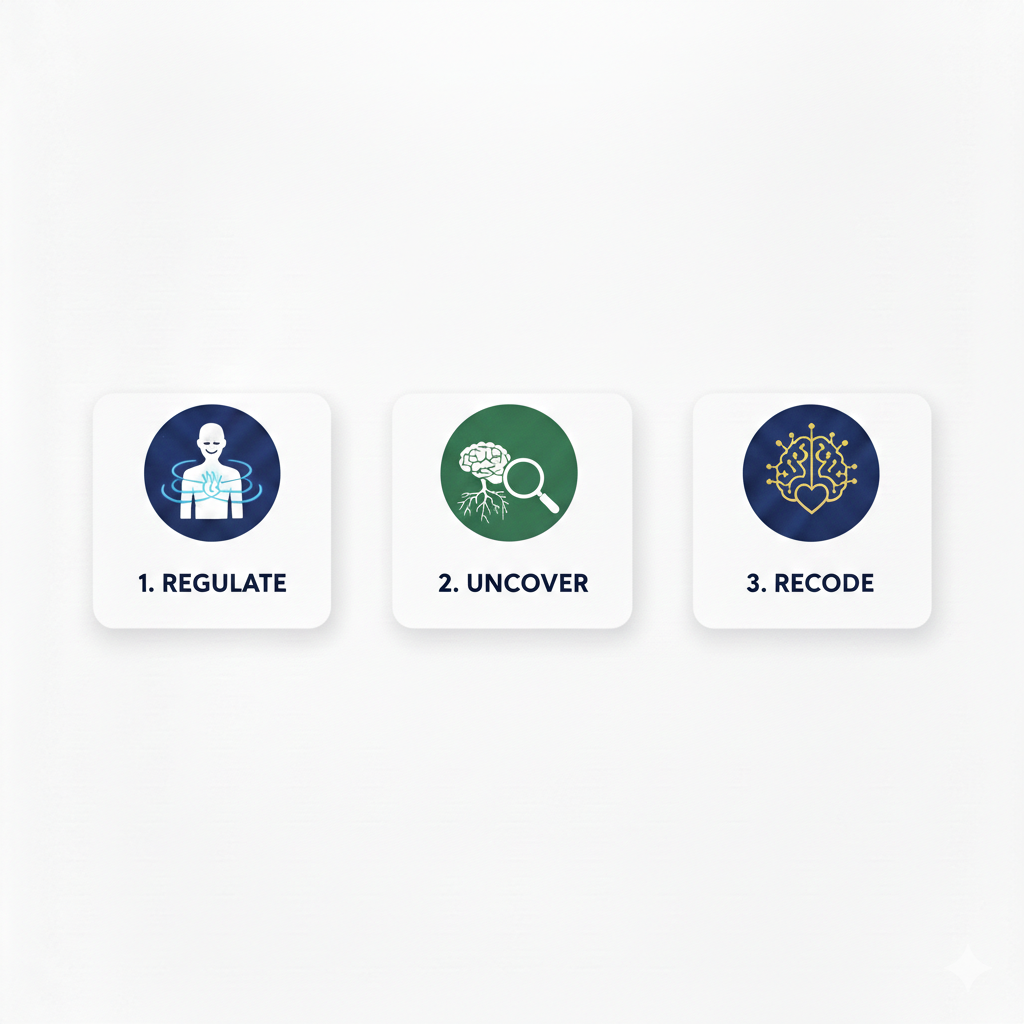
Emotional Resilience Training 3 Step Process
Regulate (The Short-Term Win): We teach specific tools for body regulation to clear tension and drop emotional activation instantly.
Uncover (The Root Cause): We identify the core limiting beliefs—such as "I'm not smart enough to decide" or "It's not safe to speak up" that cause the emotional activation.
Recode (The Permanent Shift): Using neuroplastic techniques, we help leaders install empowering beliefs that ensure the change sticks at a nervous system level rather than just a mental one.
From Theory to Real-Time Execution
Understanding the science of the nervous system is the foundation, but resilience is built in the "gap" between a trigger and your reaction. To move from understanding your limiting beliefs to actually shifting your state under pressure, you need a bridge.
One of our most popular and effective tools is the 3rd-Person Pivot. We use this tool to help leaders "intervene" in their own nervous system response, allowing them to reset their physical presence before it impacts the team. It helps leaders realize, on their own, that they are reacting defensively, shutting down, or feeling overwhelmed.
The "3rd-Person Pivot": A Tool for High-Stakes Presence
A 5-minute visualization technique used by our clients to shift from reactive to grounded before critical situations like meetings.

Leadership Resilience Training 3rd-Person Pivot
Step 1: Observe. Close your eyes and see yourself from a 3rd-person POV in an upcoming stressful scenario. Notice the "data" your body is giving: a tight jaw, shallow breathing, or a defensive posture.
Step 2: Somatic Release. Focus your breath into those specific areas of tension. As you exhale, physically signal "safety" to your nervous system by relaxing those muscles.
Step 3: Re-Imagine. Adjust your posture in your mind’s eye to be open, steady, and straight. Re-visualize the scenario with this new physical presence.
Leadership Case Studies: Proven Outcomes
Evidence of how recoding internal beliefs changes organizational performance.
The Decision-Making Block (Tech Manager)
A leader consistently deferred decisions to her teammates and director because she believed she was a “democratic leader”. But she was actually pushing her decisions onto them because she unknowingly had a limiting belief of - "I'm not smart enough to make decisions on my own”. We recoded her mindset to "I've got this." She broke the block immediately and received her strongest feedback from her director in over a year.
The Perfectionist Bottleneck (Fitness Director)
A director would spend a lot of time on projects, trying everything he could to make them perfect. Often leading him to feel burntout and become a drain on his team’s resources. We uncovered the limiting belief. If the project failed, it also meant - "I am a failure." By shifting this to a belief of “I can’t wait to fail 1,000 times”, he became more excited and relaxed. He then prepared for an executive meeting in half the time and got the best feedback he has received in the 4 years working there.
The Reactive Manager (Manufacturing)
A leader prone to frustration and "clenched fists" when asked for help from his team, had a belief that “If my high standards aren't met, that means people are lazy”. We helped him reframe his view of team errors to "When they aren't able to achieve the goal, then they need my help,” dropping his frustration from a 10 to a 3.
Why Partner With Lead By Impact?
Our programs are led by a Master of Clinical Psychology with a track record of coaching, facilitating and training thousands of people. We don't relive the stories of the past; we provide a "strength training" syllabus that creates a new leadership identity rooted in values and grounded in belief.
“Game changing... I experienced multiple tangible shifts in how I show up at work... going from work anxiety and self-doubt to my boss giving me the best feedback I’ve gotten in 4 years.”
-
One-on-One Coaching
Individual coaching provides a highly personalized experience, allowing managers, leadership, or other individuals to work deeply on their own emotional patterns, stress responses, and growth areas.
Small Group Training
Group sessions create a shared learning experience among leaders, helping normalize challenges and build collective emotional resiliency. Participants learn from one another while developing skills they can immediately apply with their teams.
-
Yes. Emotional resilience is a skill set—like driving or financial modeling—that requires practical tools rather than just abstract theory.
-
We move past surface mindset shifts. By removing the limiting beliefs that cause the stress, we ensure your leaders don't just "push through", they actually show up differently.