6 Psychological Safety Exercises That Actually Work (And 1 System to Keep Them Alive)
Most "trust-building" exercises are a waste of time.
You’ve seen them before: the trust falls, the awkward icebreakers, or the "vulnerability parties" where everyone shares a personal secret. While well-intentioned, these activities often backfire. If a team doesn't already feel safe, forcing them to be vulnerable actually increases their sense of risk.
When Google’s Project Aristotle discovered that psychological safety was the #1 predictor of team success, they weren't talking about being "nice." They were talking about a team’s ability to take risks without fear of being punished.
To build that, you don't need games. You need systems. Here are six psychological safety exercises we use in our Psychological Safety Workshop that move the needle by focusing on behaviors, not just feelings.
Exercise 1: The "Safety Anchor" (A Personal Reflection)
Before we dive into fixing the team’s friction points, we have to understand what safety actually feels like. Most people can’t define "Psychological Safety," but they can easily describe a person who makes them feel safe. This is a low risk exercise that gets people into the mindset and feeling of psychological safety.
How to do it:
Reflect: Ask everyone to think of one person in their life they feel completely comfortable opening up to. A spouse, a sibling, a childhood friend, a former mentor, etc.
Identify the "Why": Have them write down 3–5 specific traits or behaviors that person has. What is it about them that makes it easy to be honest? (e.g., "They don't interrupt," or "I know they won't judge me if I'm wrong.")
The Share: Have the team share these components with one another.
Why it works: This creates a shared "Success Profile" for the team. It reminds everyone that safety isn't a corporate buzzword; it’s a set of human behaviors that we already value in our personal lives. Using this as "inspiration" ensures that the team is aiming for a feeling they’ve actually experienced.
Exercise 2: Scenario-Based Anonymous Collection
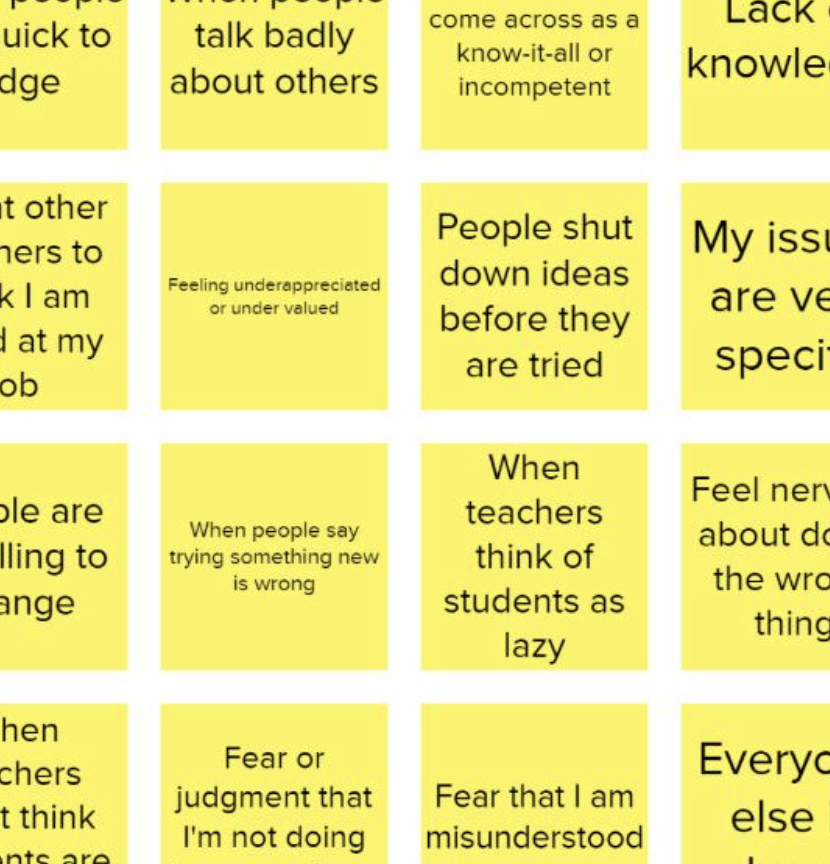
The biggest barrier to safety is the Hierarchy Trap. If a leader asks, "Does anyone have concerns?" the silence that follows is what we call the Silence Tax. People are calculating the social cost of speaking up and deciding it’s too high.
How to do it:
Choose a Scenario: Don't try to solve "culture" all at once. Pick a specific friction point, like "Our Weekly Stand-ups" or "How we give feedback on code."
Go Anonymous: Have the team write their challenges on sticky notes. In person, place them face-down. Digitally, use a blurred virtual board.
The Reveal: A facilitator (or a team member) puts them all on a wall for everyone to see.
Why it works: It separates the person from the problem. It allows the truth to enter the room without anyone having to put a target on their back.
Exercise 3: The "Art Walk" (Targeted Focus)
Once the challenges are on the wall, the team often feels overwhelmed. Psychological safety is built when people feel heard and considered, but they also need to feel focused.
How to do it:
Have the team walk around and read every note (the "Art Walk").
Give everyone three "dot votes."
Ask them to vote on the challenge that, if solved, would have the biggest impact on their daily work.
Discuss the top voted challenges. Focus on understanding the issue, not blaming others.
Why it works: You aren't saying "no" to anyone's ideas. You are allowing the team to democratically decide where to point their energy.
Exercise 4: Behavior-Based Solutioning
The reason most culture initiatives fail is that they stay in the clouds. "We need to be more respectful" is a nice sentiment, but it’s a vague concept. You can't "do" respect; you can only do behaviors that look like respect.
How to do it:
Take the top-voted challenge from Exercise 2.
Using the same anonymous format, ask: "What is one specific behavior we could adopt to fix this?"
The Filter: Move from concepts to actions.
Bad Solution: "Communicate better." “Respect each other.”
Good Behavior: "Send the meeting agenda 24 hours in advance." “Ask clarifying questions before disagreeing.”
Why it works: It turns abstract "safety" into a measurable operating system.
Exercise 5: The "Clarify" Map
Conflict often happens because of "assumed knowledge." Someone says something confusing, or unclear and others are too afraid to ask for clarification because they don't want to look "slow."
How to do it:
Once you pick a solution, give people time to write out the specific steps in doing the new behavior.
One step per sticky note. Then post them up on a wall, so each person has one row of steps on the wall.
Do another art walk and have the team vote for the row that is most clear and would help people be safe to open up
Open up the discussion and ask clarifying questions, also point out what may be missing from the row the team voted on that we should include to make this new behavior successful. Feel free to pull a step from other rows. But end with 1 main row so that the team is clear on next steps.
Why it works: By clarifying the steps you go from vague to specific, you get aligned and remove the risk of people not doing the behavior.
Exercise 6: The 2-Week Experiment
Psychological safety dies when people feel like they are being forced into a permanent, "perfect" change. It's not about getting it right, it's about learning and eventually finding what really works.
How to do it:
Take the steps from Exercise 4 and frame it as a Time-Bound Experiment.
Say: "We aren't changing our culture forever. We are going to try this behavior for X weeks."
Set a calendar invite to review it at the end of the X weeks.
Why it works: It’s much easier to take a risk when the "cost of failure" is limited to a short time frame.
The Missing Step: Continued Collaboration
Exercises are just the beginning. To rank as a high-performance team, these exercises must become your Collaborative Safety Cycle.
After your 2-week experiment, ask the team: "What worked? What didn't? Do we pivot or keep going?" This rhythm of feedback is what creates a permanent "operating system" of safety.
Ready to build a high-efficiency team?
Running these exercises for the first time can be difficult when you are the one in charge. The "weight" of your leadership can accidentally stifle the very honesty you're trying to invite.
Our Psychological Safety Workshop provides a neutral, expert facilitator to guide your team through the Collaborative Safety Cycle. We help you identify the "Silence Tax" and turn it into a competitive advantage.