Free Psychological Safety Survey: Measuring Psychological Safety to Improve Team Trust
Fill out the form below to download you FREE psychological safety survey
As a leader, you can’t manage what you don’t measure. If you suspect your team is playing it safe, withholding ideas, or staying silent during critical meetings, a psychological safety survey is your first step toward a high-performance culture.
However, many organizations make a critical mistake: they run the survey, look at the data, and then… nothing happens. This actually decreases safety because employees feel their honesty was wasted.
In this guide, we will provide the industry-standard 7 questions for measuring safety, explain how to score them, and show you how to use the Collaborative Safety Cycle we use in our psychological safety workshops to turn that data into a culture of impact.
The Gold Standard: Amy Edmondson’s 7 Questions
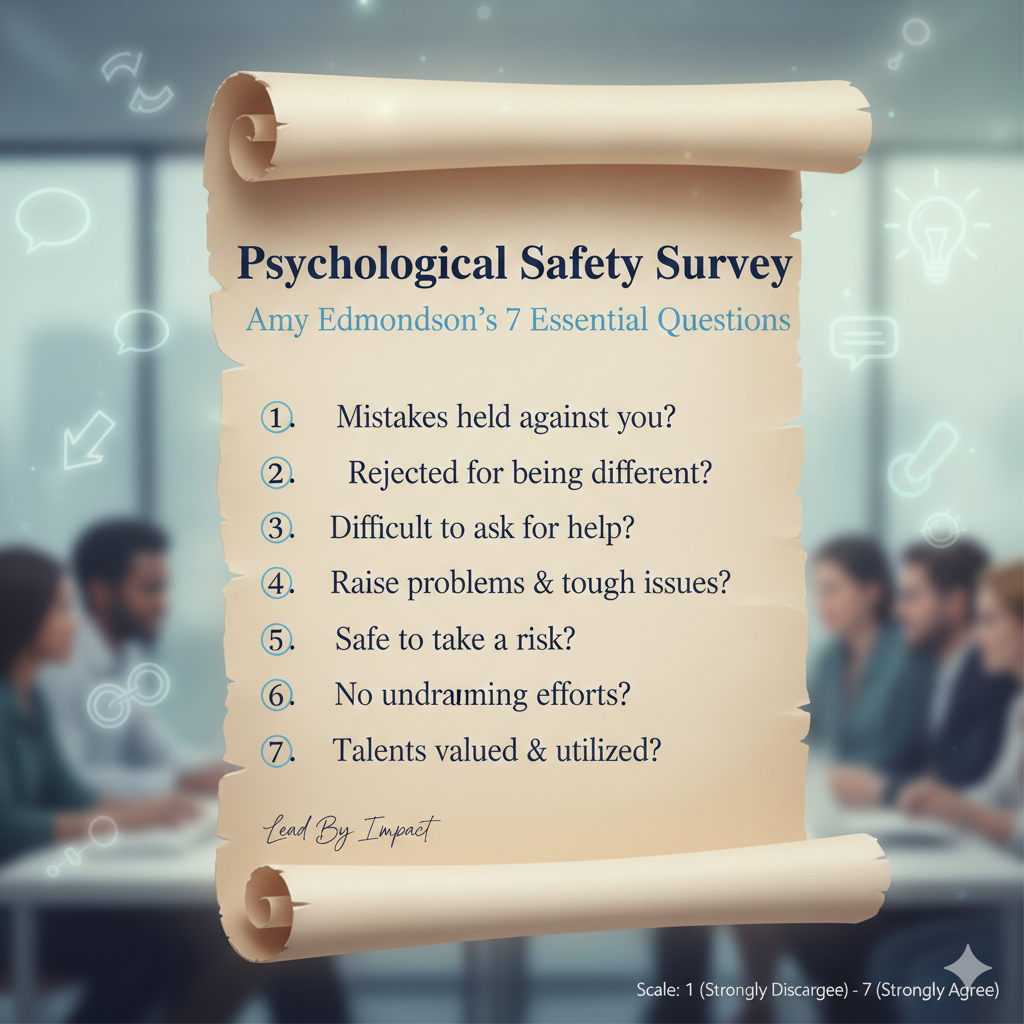
Harvard Professor Amy Edmondson developed a specific 7-question scale to assess how safe a team feels taking interpersonal risks. When conducting your psychological safety survey, ask your team to rate these statements on a scale from 1 (Strongly Disagree) to 7 (Strongly Agree).
If you make a mistake on this team, it is often held against you.
People on this team sometimes reject others for being different.
It is difficult to ask other members of this team for help.
Members of this team are able to bring up problems and tough issues.
It is safe to take a risk on this team.
No one on this team would deliberately act in a way that undermines my efforts.
Working with members of this team, my unique skills and talents are valued and utilized.
Understanding "Reverse Scoring"
To get an accurate result, you must use "reverse scoring" for Questions 1, 2, and 3.
Because these questions are phrased negatively, a "Strongly Disagree" (1) actually indicates high psychological safety. When calculating your team's average score, you must flip these values (e.g., a 1 becomes a 7, a 2 becomes a 6).
If your team scores low overall, it’s a sign that they are in "defensive mode," protecting themselves rather than focusing on the mission.
Beyond the Score: The Need for Clarity of Process
A survey can be anxiety-inducing for a team that already lacks trust. To ensure you get honest data, you must provide Clarity of Process. Before sending the survey, clearly communicate:
Total Anonymity: Explain exactly how you are keeping the results anonymous to separate the person from the problem.
The Goal of Alignment: State clearly that this is not a "witch hunt." The goal is to identify the main challenges everyone agrees on so the team can align on a solution.
The "No-Put-Down" Rule: During the debrief, we don't shoot down ideas. We use voting to focus energy only on the solutions the team aligns with.
From Data to Action: The Collaborative Safety Cycle
Once your psychological safety survey is complete, you have a "map" of where the trust gaps are. But a map doesn't move the car. To improve your score, we recommend the Collaborative Safety Cycle:
Anonymous Collection: Use the survey results to prompt a specific "Art Walk." Ask the team to write anonymous sticky notes about the root causes of the low scores.
Targeted Focus: The team votes on the one challenge they want to solve first. This ensures they feel Heard and Considered.
Solution Creation: Brainstorm specific behaviors (e.g., "We will use 5 minutes of silence for brainstorming before anyone speaks").
The Experiment Phase: Try the new behavior for a set time (e.g., two weeks).
Continued Collaboration: Debrief the experiment. Did it make people feel more Included? Refine and repeat.
Why a Facilitated Workshop is the Safest Path
Interpreting survey results can be difficult for a leader because the existing hierarchy can stifle the conversation. If a leader asks, "Why did we score low on help-seeking?" the team might be too afraid to answer honestly.
Bringing in an external facilitator to run a Psychological Safety Workshop allows a neutral third party to facilitate this transition. In our workshops, we help you:
Run the survey and analyze the data through the lens of being Heard, Considered, and Included.
Facilitate the Collaborative Safety Cycle so the team can discuss "tough issues" without fear.
Bridge the gap between "we have a problem" and "we have a plan."
Conclusion: Don't Let the Data Sit on a Shelf
A psychological safety survey is a powerful tool, but its value is determined by what happens after the results are in. By combining these 7 questions with a clear, collaborative framework, you show your team that their safety is your strategic priority.
Ready to bring a Psychological Safety Workshop for your team. Click the button below!