
What is Psychological Safety in the Workplace?
A Leaders Guide to High-Performance Culture
Psychological safety in the workplace is when leaders and teams members can speak openly without the fear of negative consequences. Whether you are a CEO, a Director, or an HR leader, you’ve likely seen the symptoms of a silent culture: missed deadlines, problems not addressed, "quiet quitting," or a recurring "surprise" resignation from a top performer. While these look like productivity issues, they are often symptoms of a lack of psychological safety.
So let’s dive deeper into what is psychological safety in the workplace.
Since Google’s landmark Project Aristotle study identified psychological safety as the #1 predictor of high-performing teams, the term has become a corporate buzzword. But for many organizations, it remains a vague concept rather than a functional strategy.
This is exactly why we facilitate our Psychological Safety Workshop—to help leaders bridge the gap between theory and a high-performance reality."
In this guide, we’ll define exactly what psychological safety is, why it is the backbone of organizational ROI, and—most importantly—how to move past the theory and implement it using the Collaborative Safety Cycle.
Here are the 5 steps in the Collaborative Safety cycle
1 - Anonymous Collection
2 - Targeted Focus
3 - Solution Creation
4 - The Experiment Phase
5 - The Continued Collaboration
More detail about each of the steps below!
Defining Psychological Safety: Beyond "Being Nice"
The most widely accepted definition comes from Harvard Professor Amy Edmondson:
"Psychological safety is a belief that one will not be punished or humiliated for speaking up with ideas, questions, concerns, or mistakes."
What most blogs get wrong: Many leaders mistake psychological safety for "politeness" or a lack of accountability. In reality, it is the opposite. It is about creating a high-candor environment where people feel safe enough to take interpersonal risks. Without it, your team operates in a "defensive mode," wasting valuable cognitive energy on self-protection rather than innovation.
The 3 Core Principles of a Psychological Safe Culture
To move from theory to reality, leaders must ensure employees feel three specific things. At Lead By Impact, we view these as the non-negotiables:
Feeling Heard: Not just being listened to, but seeing evidence that their contribution was captured.
Feeling Considered: Knowing that even if their idea isn't used, it was weighed seriously against the goals.
Feeling Included: Believing that their presence is vital to the group’s ultimate success.
The Missing Link: Clarity of Process to Create a Sense of Safety
One of the greatest "safety killers" in the workplace isn't a toxic boss—it's ambiguity. When a process (like conflict, decision-making or brainstorming) is unclear, employees default to silence to avoid negative consequences. High-ranking psychological safety blogs rarely mention this, but Clarity is Safety. By standardizing how we navigate conflict, share ideas, you remove the social anxiety of participation.
Introducing the Collaborative Safety Cycle - A 5 Step Framework for Creating Psychological Safety
Most organizations struggle to build safety because they ask people to be "vulnerable" without providing a structure to do so. We facilitate the Collaborative Safety Cycle, which is a 5-step framework designed to remove hierarchy and encourage equitable contribution:
1. Anonymous Collection
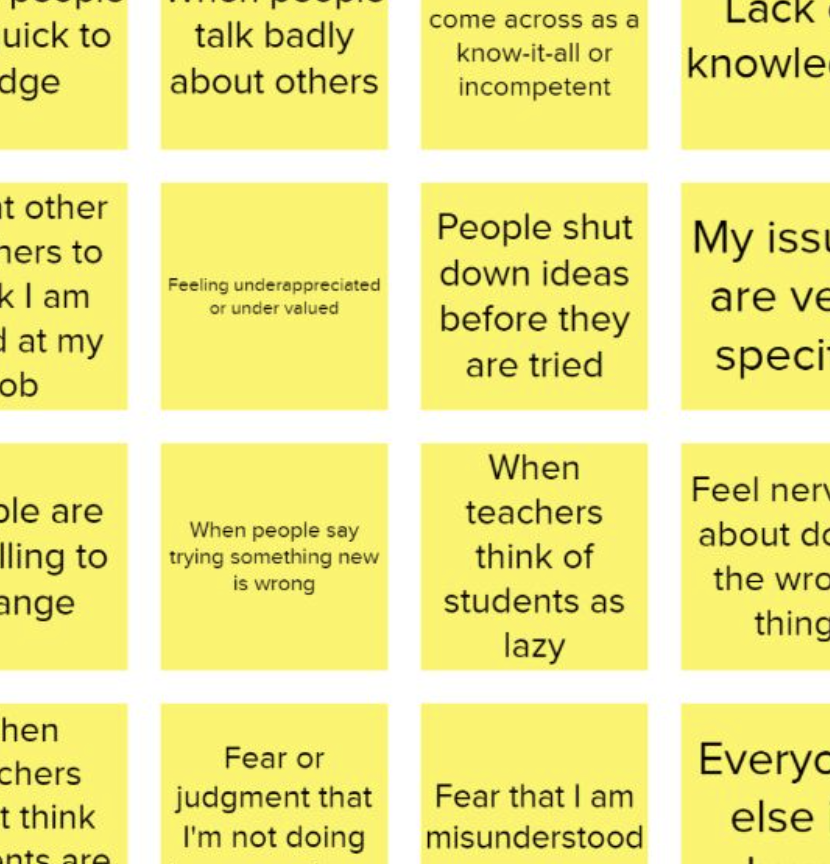
Don’t ask "Does anyone have concerns?" in a meeting. Walls are instantly put up since they are worried about what might happen to them if they speak up.
Instead, have the team write challenges on sticky notes. In a physical office, place them face down; in a digital space, use a virtual whiteboard. Then have someone put them up on the wall for all to see. This separates the person from the problem.
Side note - It’s helpful to keep the discussion focused around a specific scenario like performance reviews or the weekly stand up. If you try to create general psychological safety, it will be too broad. So focus on a specific scenario where people may not feel comfortable opening up.
2. Targeted Focus
Next, use the "Art Walk" method. The group looks at all the challenges and votes on which specific challenge to tackle, ensuring the team feels heard and considered regarding their daily friction points. We aren’t saying “no” to anyone's ideas, we are focusing on the ones the team feels are the biggest challenges.
3. Solution Creation
Brainstorm solutions using the same anonymous, equitable format. Write ideas down, put them up on a wall, and vote on the ones the team wants to try. This protects introverts and ensures the "loudest voice" doesn't dominate the strategy.
Side note - Make sure the ideas are specific behaviors, not vague concepts. Being more “respectful” is a nice concept, but vague. Asking clarifying questions before disagreeing with someone is very clear and specific.
4. The Experiment Phase
Commit to a small, time-bound experiment of when you will try the behaviors. Safety is built when teams see that "trying and failing" is part of a structured process, not a personal flaw.
5. Continued Collaboration
Hear what people feel about the new behavior. What worked, what didn’t, refine the behavior, and repeat. This creates a rhythm of safety that becomes the team's "operating system."
Why Your Organization Needs a Psychological Safety Workshop
Reading about safety is the first step; building the "muscle" requires facilitation. Most executives find that internal attempts to build safety can be awkward because the existing hierarchy is still in the room.
Bringing in a Psychological safety workshop provides a neutral ground where:
Leaders can practice Micro-Behaviors (like asking three clarifying questions before critiquing).
Teams can experience the Art Walk methodology firsthand (whether in-person or digitally).
Individuals learn to build Internal Safety, regulating their own stress responses during high-stakes collaboration.
Conclusion: Safety is a Competitive Advantage
Psychological safety isn't a "soft skill"—it's a hard requirement for any organization that relies on human intelligence. When you clarify your processes and implement a repeatable cycle of inclusion, you don't just make people "happier", you unlock the full potential of your workforce.
Ready to transform your culture?
Explore how we can help your team implement the Collaborative Safety Cycle to drive innovation and retention.